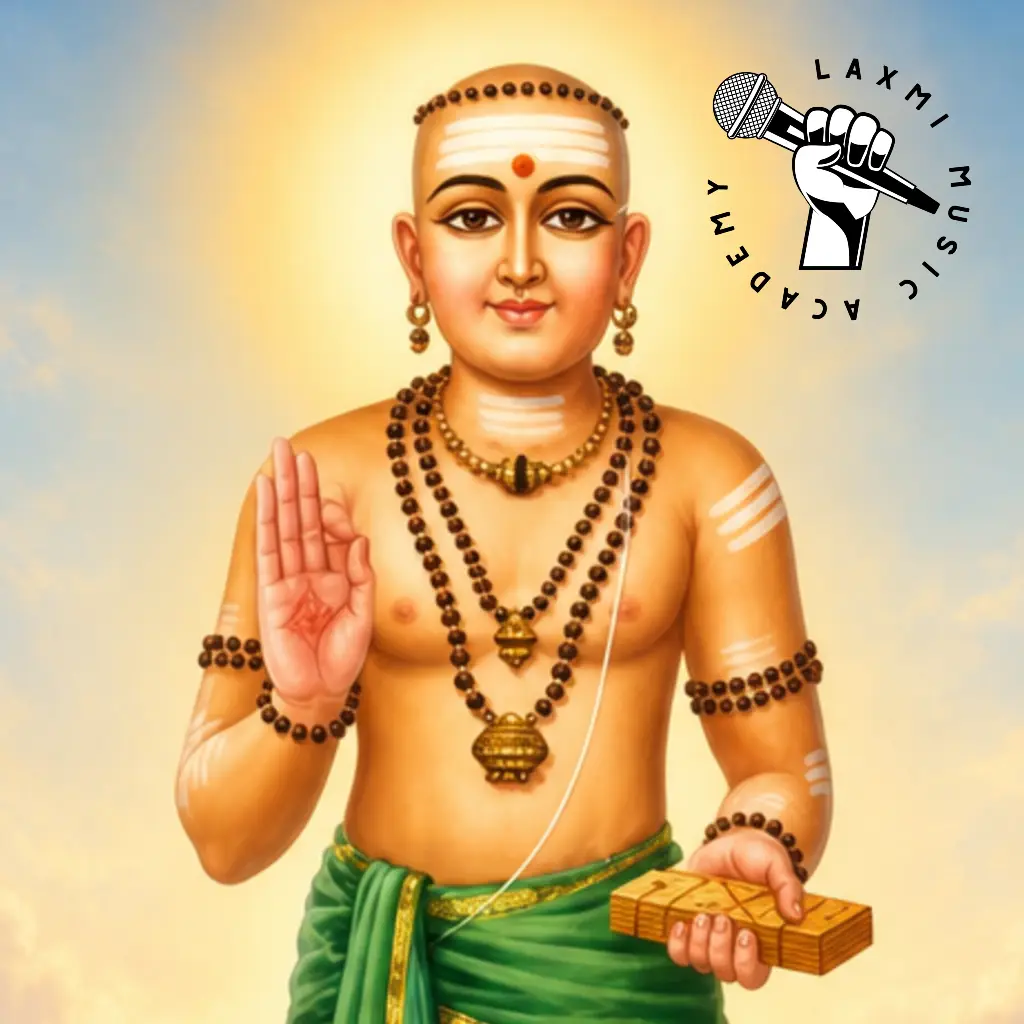
 Life & Miracles
Manikkavasagar
Thiruvasagam · Tirumurai 8 ⏱ 11 min readHis work is the Thiruvasagam rather than Thevaram proper, yet Manikkavasagar (also spelled Manickavasagar) is inseparable from this tradition, honoured alongside Sambandar, Appar and Sundarar as one of the four great teachers of Tamil Shaivism. His hymns express the soul's transformation through pure devotion.
In Short
Manikkavasagar (மாணிக்கவாசகர்) was a Tamil Shaiva saint and poet, usually placed in the ninth century. He is also written as Manickavasagar, Manikkavacakar and Manikavasagar. He was born Vadavoorar at Tiruvadhavur near Madurai and served as chief minister to the Pandya king before giving up everything to follow Lord Shiva.
He wrote the Thiruvasagam, meaning sacred utterance, which forms the eighth book of the Tirumurai together with his Tirukkovaiyar. His work is not part of the Thevaram, yet he is honoured with Sambandar, Appar and Sundarar as one of the Naalvar, the four great teachers.
Quick Facts
- Also known as
- Manickavasagar, Manikkavacakar, Vadavoorar
- Tamil
- மாணிக்கவாசகர்
- Period
- commonly placed in the 9th century CE
- Birthplace
- Tiruvadhavur, near Madurai
- Former role
- chief minister to the Pandya king
- Main works
- Thiruvasagam (51 compositions), Tirukkovaiyar (400 verses)
- Tirumurai book
- 8
- Temple he built
- Avudaiyar Koil at Tirupperunturai
- Where he merged with Shiva
- Chidambaram
The King's Minister
About twelve hundred years ago, a boy was born into a learned family in the village of Tiruvadhavur, near Madurai. They named him Vadavoorar.
His mind was remarkable. He mastered both Tamil and Sanskrit while he was still young, and word of his brilliance reached the Pandya king himself.
He was made a royal minister. He was wealthy, powerful and trusted with the affairs of the kingdom, and he rose so fast that older men at court marvelled at how young he was to carry so much. In time the king gave him the title Thennavan Brahmarayan, chief among his ministers.
By every worldly measure, his life was already a success. He had no idea that all of it was about to fall away.
The Guru on the Road
One day the king handed him a large sum of gold and sent him to the coast to buy horses for the royal cavalry.
On the way he came to a place called Tirupperunturai. There, under a spreading tree, he found a group of ascetics gathered around a teacher he had never seen before. That teacher was Lord Shiva himself, walking the earth in human form.
Everything changed in that one meeting. He sat down at the teacher's feet and learned more in a single conversation than his whole life at court had taught him. The horses, the gold and the king's orders stopped mattering to him completely.
He spent the royal treasure on building a temple to Shiva on that very spot. It still stands today and is known as Avudaiyar Koil.
He was so moved by the beauty of what the Lord had spoken that he was given a new name there and then. Manikkavasagar, meaning the one whose every word is a ruby.
The horses, the gold, the king's orders. All of it stopped mattering.
When Jackals Became Horses
Word got back to the king, who summoned his minister to explain the missing gold and the missing horses.
The Lord did not abandon the man he had claimed. By a miracle, Shiva turned a pack of wild jackals into a fine herd of horses and delivered them to the king. The order was fulfilled and the devotee was protected, at least for a while.
It did not last. That same night, as the sun went down, the spell broke. In front of the whole astonished court, the horses turned back into jackals and went howling through the palace grounds.
The king was furious. Certain that he had been made a fool of, he had Manikkavasagar bound and thrown into prison.
The Flood of the Vaigai
Shiva was not finished proving his devotee's innocence. He sent a flood rushing down the Vaigai river towards Madurai.
The water rose so fast that the king ordered every household to send one worker to help build an emergency embankment, and anyone who failed to send someone would be fined.
An old woman named Vanthi had nobody to send and no money to pay the fine. She stood on the riverbank in despair.
Shiva came to her as an ordinary day labourer and offered to carry earth in her place. He asked for nothing but a rice cake as his wage.
Then he worked badly on purpose, carrying far less earth than anyone else. When the king's overseer struck him for laziness, the blow did not land on the labourer at all. It landed on the king's own body, and left a mark no doctor could explain.
In that moment the king understood everything. The labourer had been Shiva all along, and the minister sitting in his prison was no trickster. He was a true devotee under the Lord's own protection.
Ashamed, the king set Manikkavasagar free and asked his forgiveness. With his worldly duty behind him, Manikkavasagar walked away from rank and riches for good and became a wandering ascetic, with nothing but the presence of Shiva to guide him.
The Silence That Learned to Speak
Years later at Chidambaram he faced one final test. The king of Sri Lanka's daughter had lost the power of speech. Buddhist scholars came over from the island to settle the matter through public debate, confident that no Shaivite teacher could out argue them.
Manikkavasagar accepted the challenge in front of the great Nataraja shrine.
When argument alone would not move them, he turned to the mute princess and asked her, by Shiva's grace, to speak. In front of the whole assembly she answered him clearly, in perfect Tamil and Sanskrit.
The debate was over before another word was needed. The Buddhist scholars, seeing what no scholarship could achieve, became Shaivites on the spot.
The Sacred Utterance
Out of his love came the Thiruvasagam, meaning the sacred utterance. The verses feel like they come straight out of the soul. They carry the ache of being far from God and the joy of coming close again.
Its opening hymn is the Sivapuranam. It is still recited at the start of worship in temples and homes all over Tamil Nadu, and it is often the first prayer a Tamil child learns.
He also wrote the Tirukkovaiyar, four hundred verses that use the language of romantic love as a picture of the soul longing for God. His two works together form the eighth book of the Tirumurai.
Tamils still say that if a heart will not melt for the Thiruvasagam, it will not melt for anything.
The work is made up of fifty one separate compositions, each in a different mood and metre. It moves through despair, longing, gratitude and joy, almost like a diary kept by a soul in conversation with God. Some traditions hold that Lord Shiva himself wrote the verses down as Manikkavasagar sang them.
One part of it, the Thiruvempavai, is still recited every single day through the Tamil month of Margazhi in Shiva temples across Tamil Nadu. For one month every winter, a whole state wakes up to his words before dawn.
Merging at Chidambaram
His end came the way his life had, without warning. At the Chidambaram temple, in front of the sanctum of Nataraja, Manikkavasagar spoke his final words and vanished into the light of the Lord he had spent his life seeking.
There was no tomb, no last illness and no farewell. Only the sudden disappearance of a man who had already given everything else away.
His Place Among the Teachers
Manikkavasagar is not counted among the sixty three Nayanmars, yet Tamil Shaivam holds him as their equal. Along with Sambandar, Appar and Sundarar he is honoured as one of the Naalvar, the four great teachers, even though his masterwork sits in its own book of the Tirumurai rather than among the Thevaram hymns.
Some later traditions say he was sent into the world for one purpose only, to compose the Thiruvasagam. A single complete offering rather than a lifetime of scattered verse.
He is remembered most of all at Avudaiyar Koil, the temple he built with the king's gold. It is unusual among Shiva temples because its main shrine holds no image of Shiva at all, only an empty pedestal, as a reminder that God is beyond any form the eye can hold.
The name he was given that day at Tirupperunturai outlasted every title the Pandya court ever gave him. Nobody calls him minister now. Everybody calls him the one whose words are rubies.
Why His Story Still Matters
His life carries one message that still lands hard. Real happiness is not found in gold or rank or power. It is found in loving God without conditions.
He had already reached the very top of worldly success, and he walked away from all of it in a single afternoon. He counted himself richer for it.
His songs are still sung, in temples at dawn and in homes at dusk, teaching each new generation to live with faith and humility, exactly as they did twelve centuries ago. If you would like to learn to sing them properly, that begins with Sangeetham.
Common Questions About Manikkavasagar
Who was Manikkavasagar?
He was a Tamil Shaiva saint and poet, usually placed in the ninth century. He was born Vadavoorar at Tiruvadhavur near Madurai and rose to become chief minister to the Pandya king, before giving up his position to follow Lord Shiva. He wrote the Thiruvasagam.
What does the name Manikkavasagar mean?
It means the one whose every word is a ruby. He was given the name after meeting Lord Shiva in the form of a teacher at Tirupperunturai.
Why is the Thiruvasagam not part of the Thevaram?
The Thevaram is made up of the hymns of three saints only, Sambandar, Appar and Sundarar, and it fills the first seven books of the Tirumurai. Manikkavasagar came later and his work forms the eighth book. He is still honoured equally as one of the four great teachers.
What is the Sivapuranam?
It is the opening hymn of the Thiruvasagam. It is recited at the start of worship in temples and homes across Tamil Nadu and is often the first prayer a Tamil child is taught.
What is the Thiruvempavai?
It is a section of the Thiruvasagam recited every day through the Tamil month of Margazhi in Shiva temples. It is the Shaiva counterpart to the Thiruppavai recited in Vishnu temples during the same weeks.
Is Manikkavasagar one of the 63 Nayanmars?
No. He is not counted among the sixty three Nayanmars, whose lives are told in the Periya Puranam. He is instead honoured as one of the Naalvar, the four great teachers of Tamil Shaivism, alongside the three Thevaram saints.
What is the story of the jackals turned into horses?
Manikkavasagar had been sent with royal gold to buy horses, but spent it building a temple instead. To protect him, Lord Shiva turned a pack of jackals into a herd of fine horses and delivered them to the king. That night the horses turned back into jackals, and the king imprisoned him until further miracles proved his innocence.
Which temple did Manikkavasagar build?
Avudaiyar Koil at Tirupperunturai, built with the gold the king had given him for horses. Unusually, its main shrine holds no image of Shiva, only an empty pedestal.
How did Manikkavasagar die?
Tradition says he did not die in the ordinary way. At the Chidambaram temple, before the sanctum of Nataraja, he spoke his final words and vanished into the light of the Lord.