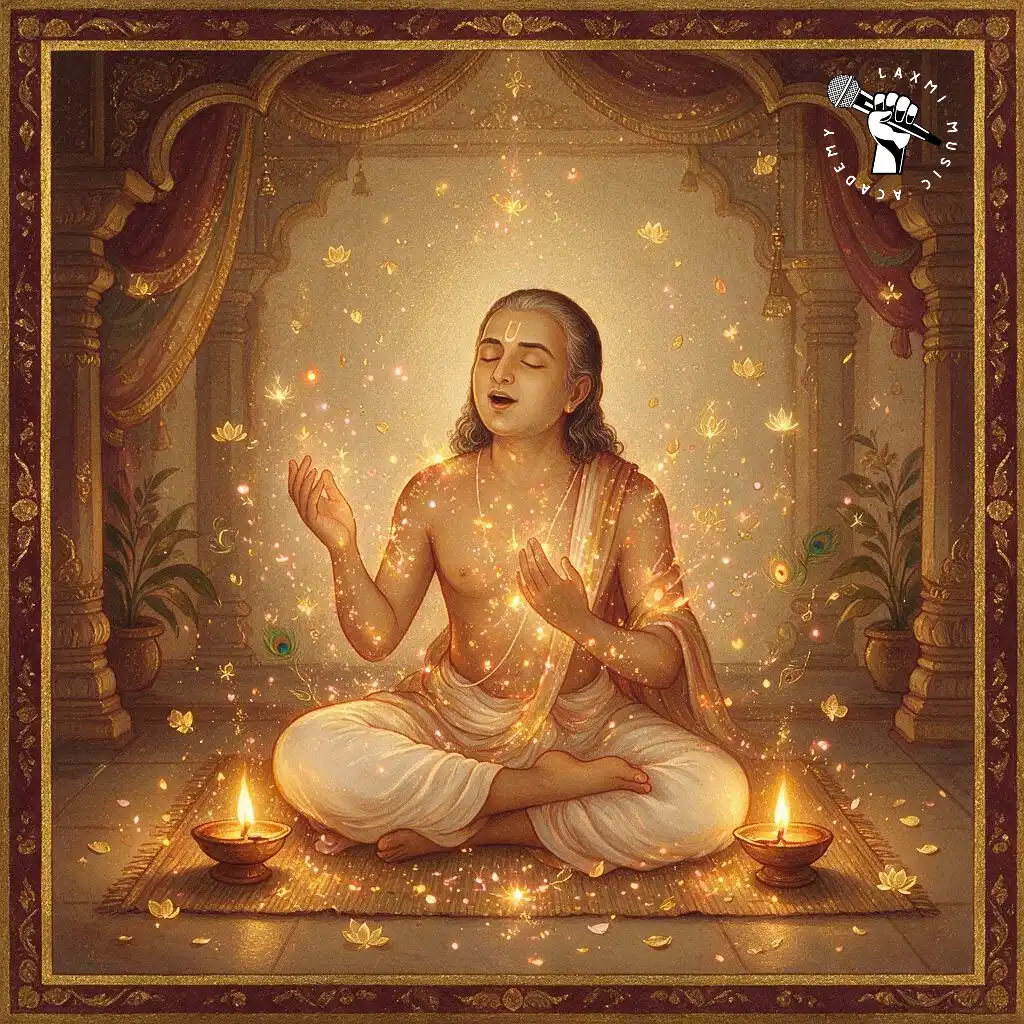
Purandaradasa: The Father of Carnatic Music
 By Mataji Laxmi · 25 July 2026 · 6 min read
The saint who gave every beginner their very first step.
My dear child, we speak often of the Trinity, and rightly so. Yet before them, nearly two centuries earlier, there lived one man without whom none of it would exist as we know it. His name was Purandaradasa, and every single lesson you have ever taken began, in a quiet way, with him.
Let me tell you why we honour him as the father of our music.
Who was Purandaradasa?
Purandaradasa lived in the fifteenth and sixteenth centuries, in what is now Karnataka. He was a wandering devotee, a saint, and a composer of extraordinary gifts. Our tradition calls him Sangeetha Pitamaha, the grandfather of music, and it is not a title given lightly. He did not merely add to the tradition, he gave it a shape it had never had before.
His two great gifts
First, he organised the teaching of music into gentle, graded steps, the very exercises every beginner still starts with today.
Second, he composed thousands of devotional songs in simple, everyday language, so that ordinary people, not only scholars, could sing their devotion aloud.
The gift of a gentle beginning
Before Purandaradasa, learning music was far less structured. He changed that entirely. He arranged the first lessons into an order that moves a student gently from the simplest sounds toward greater complexity, beginning with Sarali Varisai, then Janta Varisai, then Alankaram. Five centuries later, we still teach in exactly that order, because it still works beautifully.
Think of that for a moment. When your child sings their very first Sa Ri Ga Ma in our classroom, they are following a path a saint laid down five hundred years ago, walked since by countless others.
Every first note sung by every beginner still follows the path he laid.
Did you know?
Before becoming a saint, Purandaradasa was a wealthy merchant. The story goes that a profound encounter changed his heart entirely, and he gave away everything he owned to live simply and sing of the divine for the rest of his days.
Songs written for everyone
His compositions, called devaranamas, were written in Kannada, in plain and tender language. This was a deliberate act of love. He wanted the cook, the farmer and the child to be able to sing devotion just as easily as the learned priest. There is a beautiful humility in that choice, and it is one reason his songs have survived so long in ordinary homes and temples alike.
What this means for your child
Your child's very first lesson is not a modern invention. It is a five hundred year old gift, handed carefully from teacher to student across the centuries, and now placed gently into their hands. There is real dignity in beginning that way.
🎧 Simply listen together
There is nothing to study or prepare at home. Everything is taught gently in class, in the order he intended.
If you wish, listen to one of his devaranamas together sometime, and notice how simple and singable it feels. Entirely optional, never a task.
Come and begin where he began
To learn Sarali Varisai is, in a sense, to bow to Purandaradasa. Come to class, sing those first gentle notes, and take your place in a line of students stretching back five hundred years.
Words to know
Purandaradasa, the 15th to 16th century saint-composer honoured as the father of Carnatic music.
Sangeetha Pitamaha, the grandfather of music, the title given to Purandaradasa.
Devaranama, a devotional song, the form Purandaradasa composed in, written in simple Kannada.
Sarali Varisai, the first graded exercises he arranged, still the starting point for every student.
Your questions, answered
Who was Purandaradasa?
Purandaradasa was a 15th to 16th century saint-composer from present-day Karnataka, honoured as the father of Carnatic music. He organised the foundational teaching exercises still used today and composed thousands of devotional songs.
Why is Purandaradasa called the father of Carnatic music?
He gave the tradition its structured teaching method, arranging the first lessons into graded steps beginning with Sarali Varisai. That framework is still followed in classrooms five centuries later.
What is a devaranama?
A devaranama is a devotional song, the form Purandaradasa composed in. He wrote them in simple, everyday Kannada so that ordinary people, not just scholars, could sing them.
Did Purandaradasa come before the Trinity?
Yes. He lived roughly two centuries before Tyagaraja, Muthuswami Dikshitar and Syama Sastri, and his teaching framework laid the groundwork that made their later compositions possible.
Wish to begin where he began?
Send us a message on WhatsApp, and we will lovingly help you or your child take that very first step, online, or here with us in Puchong.
💬 WhatsApp Us
Mataji Laxmi
Mataji Laxmi is the founder and guiding guru of Laxmi Music Academy in Puchong. A lifelong devotee of Carnatic music, she has nurtured generations of students with warmth and devotion, keeping this beautiful tradition alive for the young.