Sa Ri Ga Ma: Meet the Seven Swaras
 By Teacher Nanthini · 9 July 2026 · 5 min read
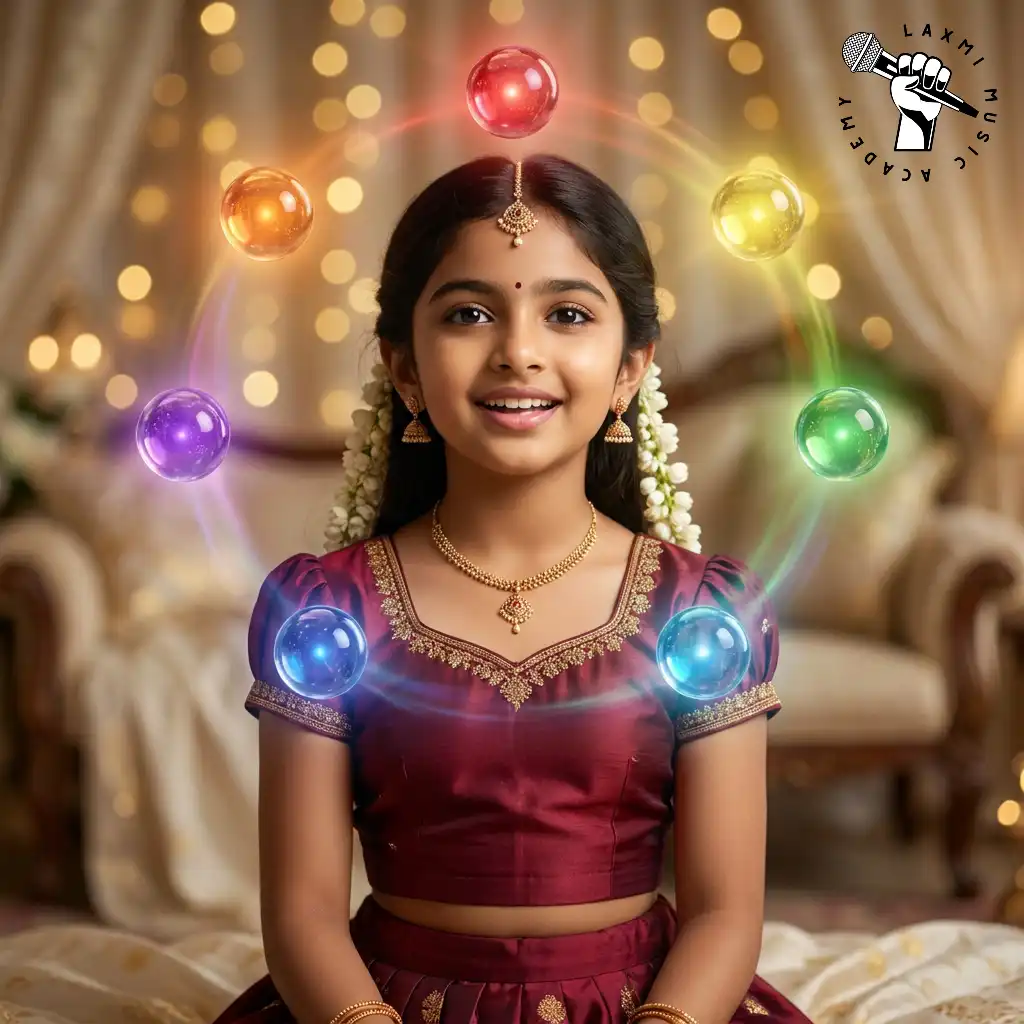
Seven little swaras, the whole of Carnatic music grows from them.
Okay, real talk: you already know the seven swaras. If you’ve ever hummed a song stuck in your head, called out to someone across the house, or sung a baby to sleep, you’ve already used them. Carnatic music just gives these seven sounds a name, a home, and a little glow-up.
When a brand-new student walks into my class for the very first time, this is exactly where we start. No hard song, no scary theory, just seven friendly swaras. Let me put you on the same way I do them. 💛
So, what is a swara?
A swara is basically a musical note. One clear sound you can sing and hold. That’s the whole vibe. In Carnatic music there are seven of them, and together we call them the saptaswara (“sapta” just means seven). Every raga, every kriti, every film bop you love? All built from these seven swaras, just remixed.
We sing them with short, easy syllables so the voice can move quickly and freely:
Say them out loud, sliding gently up in pitch: Sa Ri Ga Ma Pa Dha Ni Sa. Then roll back down: Sa Ni Dha Pa Ma Ga Ri Sa. And… that’s it. You just sang your first Sarali Varisai. Big W. 🎉
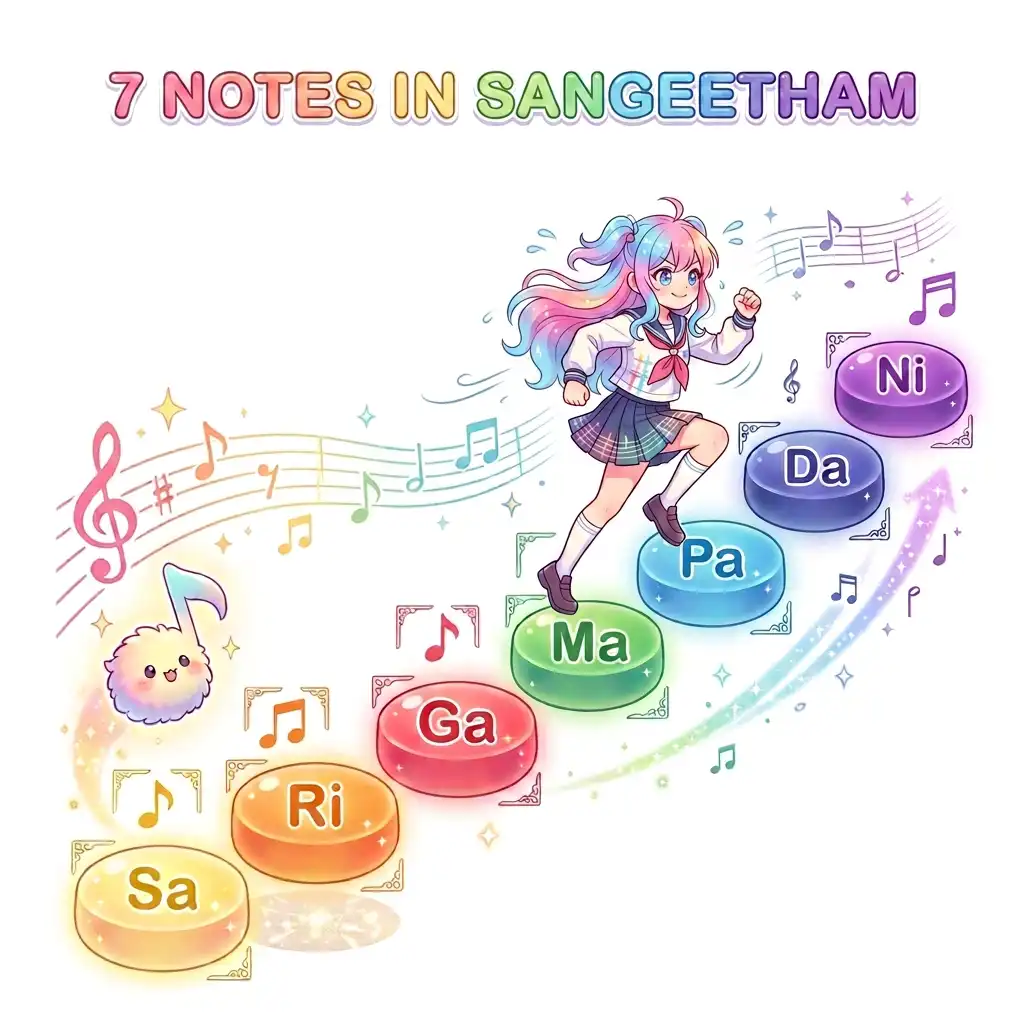
Sa: the swara that feels like home
Out of all seven, Sa is the main character. It’s our home base, the swara everything starts from and always comes back to. In class you’ll hear a soft drone humming in the background; that’s holding Sa for us so the singer never gets lost. Everything begins at Sa, and sooner or later, everything returns to it.
Pa is Sa’s day-one. Those two stay fixed and steady. The other five swaras (Ri, Ga, Ma, Dha, Ni) are a bit more playful: each can sit slightly higher or lower, and those tiny shifts are what give one raga its sweetness and another its drama. But don’t stress about that yet, that’s a story for another day.
Every song you’ve ever loved? Just these seven swaras, arranged with a whole lot of love.
Did you know?
According to a beautiful old tradition, each swara was inspired by a sound from nature, Sa from the peacock’s call, Ri the bull, Ga the goat, Ma the heron, Pa the cuckoo, Dha the horse, and Ni the trumpeting elephant. Nature really understood the assignment.
Why only seven?
Parents ask me this all the time: “Only seven swaras, how does that make thousands of songs?” Here’s the magic. Those seven swaras repeat, higher and lower, like the same seven colours showing up in every rainbow. Go above Ni and you land on a brighter Sa; dip below Sa and you hit a deeper Ni. Add the little bends and slides we call gamaka, and suddenly seven swaras can paint a whole sky of melodies.
Think of it like the alphabet. Just a handful of letters, remixed endlessly, gives us every poem ever written. Seven swaras do the exact same thing for music. It hits different once that clicks.
Why this is secretly great for you (and your child)
Learning to hear and sing the seven swaras trains the ear like nothing else. Kids who learn them in class build sharper listening, stronger memory, and better focus, the same skills that help them lock in at school. It’s music, yeah, but it’s sneaky brain-training in disguise.
🎧 Good news: no homework
Parents are always surprised when I tell them this. We don’t send anyone home with a checklist. Everything your child needs happens right here in class, with a teacher’s ear guiding theirs.
If they wander around the house humming Sa Ri Ga Ma because they feel like it? Amazing. But it’s never a chore, and never something anyone should be nagged about. Singing should stay the thing they love.
Your journey starts here
Don’t sleep on these seven swaras just because they feel “too simple.” The most goated musicians on the biggest stages still warm up with the exact same Sa Ri Ga Ma. These seven are going to walk with you for your whole musical life, so say hi properly, and they’ll open every door that comes next.

Words to know
Swara, a musical note.
Saptaswara, the seven swaras together (sapta = seven).
Sa, the “home” swara that everything begins and ends on.
Gamaka, the graceful bends and slides that decorate a swara (more on these another day).
Your questions, answered
What are the seven swaras in Carnatic music?
The seven swaras are Sa, Ri, Ga, Ma, Pa, Dha and Ni, short names for Shadja, Rishabha, Gandhara, Madhyama, Panchama, Dhaivata and Nishada. Together they are called the saptaswara, and every Carnatic song is built from them.
What is the difference between a swara and a note?
They mean almost the same thing, a swara is simply the Indian name for a musical note. What makes a swara special is that it can be gently bent and decorated with ornaments called gamaka, giving Carnatic music its distinctive sound.
Do I need to read music to learn the seven swaras?
Not at all. Carnatic music is traditionally learned by listening and singing, from teacher to student. You learn the swaras with your voice first, reading and writing notation come much later, if at all.
At what age can a child start learning the swaras?
Most children can comfortably begin around the age of five or six, but there is no upper limit, adults can start at any age, and often pick up the swaras surprisingly quickly.
Want to sing them the right way?
The fastest way to learn the swaras is with a teacher’s ear guiding yours. WhatsApp us and we’ll help you (or your kid) get started, online or here in Puchong. Let’s get it! 🎶
💬 WhatsApp Us
Teacher Nanthini
Teacher Nanthini teaches veena and Carnatic vocal at Laxmi Music Academy in Puchong. With a warm, encouraging style, she loves guiding beginners through their very first notes, turning nervous starts into real, joyful music.