 Life & Miracles
Thirugnana Sambandar
Thevaram · Tirumurai 1 to 3 ⏱ 11 min readBorn in Sirkazhi, Sambandar (Thirugnanasambandar) received divine grace as an infant and sang hymns to Lord Shiva from the age of three. Carried from temple to temple in a palanquin for the rest of his short life, he lived only sixteen years, yet his Thevaram is renowned for its lyrical beauty, philosophical depth and spiritual authority.
In Short
Thirugnana Sambandar (திருஞானசம்பன்தர்) was a Tamil Shaiva saint of the seventh century. He is also written as Sambandar, Thirugnanasambandar, Thirujnanasambandar and Gnanasambandar. Tradition holds that he began singing hymns to Lord Shiva at the age of three, after Goddess Parvati fed him milk containing divine wisdom.
He is one of the Mudhal Muvargal, the first three saints whose hymns make up the Thevaram, alongside Appar and Sundarar. His surviving hymns form the first three books of the Tirumurai. He lived only sixteen years.
Quick Facts
- Also known as
- Sambandar, Thirugnanasambandar, Gnanasambandar, Aludaiya Pillai
- Tamil
- திருஞானசம்பன்தர்
- Period
- 7th century CE
- Birthplace
- Sirkazhi, Tamil Nadu
- Parents
- Sivapada Hridayar and Bhagavathiyar
- Tirumurai books
- 1, 2 and 3
- Surviving hymns
- 383 padhikams, around 4,100 verses
- Temples visited
- roughly 220
- Age at passing
- 16, at Achalpuram
The Child of Sirkazhi
About fourteen hundred years ago, a boy was born in the temple town of Sirkazhi, where the Kaveri delta meets the sea. His father was Sivapada Hridayar and his mother was Bhagavathiyar. They named him Aludaiya Pillai, which means the cherished child.
Sirkazhi was already an old and holy town. The great Brahmapureeswarar temple stood at its centre, and the family lived a quiet life of prayer in its shadow.
It was a hard time for Shaivam in the Tamil country. Jain and Buddhist teachers held strong influence in many royal courts. Shiva's temples were never abandoned, but they had lost much of their old standing. What the faith needed was not an army. It needed a voice nobody could argue with. It found one in a child who had not yet lost his first tooth.
The Cup of Divine Milk
He was three years old. One morning his father carried him to the temple tank and set him down on the steps, then went to bathe as he did every day.
Left alone, the little boy grew hungry and frightened. He cried out for his mother. And the Mother of the Universe answered him.
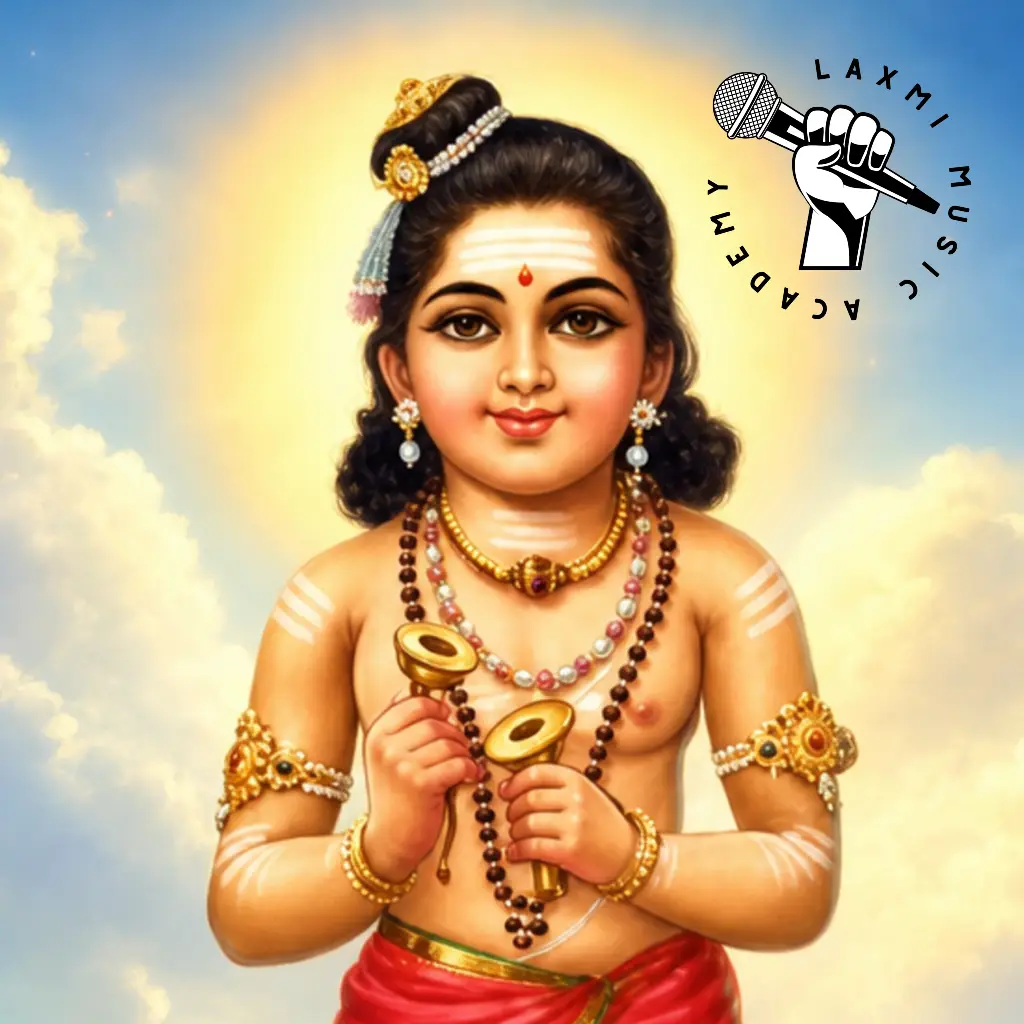
Lord Shiva and Goddess Parvati appeared before the weeping child in a light brighter than anything on earth. Parvati gathered him close and fed him, and the milk she gave held the essence of divine wisdom itself, called Jnanam. Shiva placed a small pair of golden cymbals in the child's hands so that he would never sing out of rhythm.
When his father came back, he saw a golden cup in the boy's hands and milk still on his lips. He asked in alarm who had fed him. The child lifted his hand towards the temple tower and sang. That was his first hymn, Thodudaiya Seviyan, in praise of the Lord of Sirkazhi. He could barely speak, yet the words came out perfectly formed.
From that day he was known as Thirugnana Sambandhar, the one wedded to divine wisdom.
News of the singing child spread through Sirkazhi within a day. Old scholars who had spent their whole lives studying scripture came to see him. Many of them left in tears.
A child had become a saint before he could even read.
Wonders on the Road
His devotees carried him from town to town in a palanquin, with his own father walking beside it. Over his short life he is said to have visited around 220 Shiva temples across the Tamil country, and hymns poured out of him at every stop. These songs are called padhikams.
A musician named Tiruneelakantha Yazhpana Nayanar travelled with him everywhere. He played the yazh, an old stringed instrument, so that music and devotion arrived together at every shrine.
Wonders followed the boy wherever he sang. At Mylapore lived a merchant named Sivanesa Chettiar. Years earlier he had lost his young daughter Poompavai to a snakebite, just before her wedding. He kept her remains in an urn and waited, because he had heard a prophecy that a child saint would one day bring her back. When Sambandhar came to Mylapore and heard the story, he sang before the urn. Poompavai rose from the ashes, alive and whole.
At a village called Thirumarugal he sang a merchant back to life after a snakebite. Word of these wonders travelled faster than the boy himself. By the time his palanquin reached the next temple, crowds were already waiting at the gates.
He kept nothing for himself. Kings and wealthy merchants tried again and again to give him gifts, and every time he passed them on to the devotees who fed him, housed him and carried his palanquin. The only things he owned in his whole life were the cymbals Shiva gave him and the songs that would not stop coming.
The Contest at Madurai
The hardest test of his short life came at Madurai. The Pandya king of the time, Kun Pandiyan, had turned to Jainism. He now lay in bed with a burning fever that no doctor could cure.
His queen, Mangaiyarkkarasiyar, and his minister, Kulachirai Nayanar, were both secretly devoted to Shiva. They sent word to Sirkazhi and begged Sambandhar to come.
The Jain monks of the city were determined to stop him. They challenged him to two trials, to settle once and for all whose faith was true.
In the first trial, a palm leaf with one of his hymns written on it was thrown into a roaring fire. It came out untouched. Not a single letter was scorched.
In the second, the same leaf was thrown into the fast moving Vaigai river. Instead of being carried downstream, it turned and swam back against the current. Tamils still call this wonder edhirneeraduthal, which means swimming against the flow.
As the leaf turned upstream, the king's fever broke. The pain that had bent him double eased, and by evening he was standing tall and well. People began calling him Nedumaran, meaning the tall one.
The king gave up Jainism and brought Madurai back to the worship of Shiva. A boy had won back an entire kingdom without a single blow.
Into the Light
At sixteen, a marriage was arranged for him at Achalpuram, also known as Nallur Perumanam. When the ceremony was over, Sambandhar led his bride, his family and every wedding guest into the Shiva temple.
There he sang one last time. He did not sing for himself. He asked the Lord to grant salvation to every single person standing with him.
As the last note faded, a great light opened in front of them all. This light is called the Jyothi. Sambandhar called everyone to step into it, and they did. The bride, the devotees and the saint went into the radiance together and merged with Lord Shiva.
He had come from the divine, and he returned to the divine, at an age when most lives have barely started.
His Place Among the Nayanmars
Tamil Shaivam honours sixty three Nayanmars, whose lives are told in the Periya Puranam. Three of them stand apart as the Mudhal Muvargal, meaning the first three. These are Sambandhar, Appar and Sundarar, and their hymns alone make up the Thevaram.
Add Manikkavasagar, who wrote the Thiruvasagam, and the four together are called the Naalvar, the four teachers. Their images stand at the front of nearly every Shiva temple in Tamil Nadu, and they are carried out first in every temple procession.
Sambandhar was the youngest of the three Thevaram saints and lived the shortest life. Even so, his hymns were placed first when the canon was arranged. They open the first three of the twelve Tirumurai books.
In bronze and in paintings he is always shown the way he began. A small child, one hand raised towards the sky, a pair of cymbals in the other. Forever three years old, and forever singing.
The Songs That Never Fade
Tamil tradition says Sambandhar composed an enormous number of hymns in his short life, with figures of ten thousand and sixteen thousand both appearing in the old accounts. Each one was set to a specific pann, one of the old Tamil musical modes. Scholars consider the panns an ancestor of today's raga system, and echoes of several of them still survive in Carnatic music.
Only 383 padhikams have survived, which comes to about 4,100 verses set across roughly twenty two panns. They form the first three books of the Tirumurai.
Those verses were very nearly lost. For centuries they sat locked in a chamber at the Chidambaram temple, half eaten by white ants. The Chola king Rajaraja I sent a scholar named Nambiyandar Nambi to find them. Tradition says the crumbling palm leaf bundle was recovered only with the help of Lord Ganesha. That is how the hymns of Sambandhar, Appar and Sundarar came back to the world.
His message set the whole Bhakti movement alight. Love and devotion open the path to God, not ritual alone, and that path is open to everyone whatever their birth or learning.
Why His Story Still Matters
Many Shiva temples still open their morning worship with a Thevaram hymn, and very often it is one of Sambandhar's, sung in the same pann he set it to fourteen centuries ago.
Children learning Carnatic music are often introduced to devotional singing through his simplest padhikams. Those verses suit a young voice because a young voice wrote them.
The story of Sirkazhi still offers something to every parent and every young student. Age was never the barrier everyone assumed it to be. The boy of Sirkazhi sang his way into eternity before he had learned to read a single letter, and people of every age are still singing his songs today.
Common Questions About Sambandar
Who was Thirugnana Sambandar?
He was a Tamil Shaiva saint of the seventh century, born at Sirkazhi in what is now Tamil Nadu. He is one of the four great teachers of Tamil Shaivism and one of the three saints whose hymns form the Thevaram. He is remembered above all for beginning to sing at the age of three.
Why did Sambandar start singing at the age of three?
Tradition says his father left him beside the temple tank at Sirkazhi and went to bathe. The child cried in hunger, and Lord Shiva and Goddess Parvati appeared before him. Parvati fed him milk containing Jnanam, meaning divine wisdom. When his father returned he found a golden cup in the boy's hands, and the child answered by singing his first hymn.
What does the name Thirugnana Sambandar mean?
It means the one who is wedded to divine wisdom. He was born Aludaiya Pillai, meaning the cherished child, and was given the name Thirugnana Sambandhar after the milk of wisdom he received as an infant.
How many hymns did Sambandar compose?
The old accounts give very large figures, with ten thousand and sixteen thousand both appearing in different sources. Only 383 padhikams survive today, which comes to roughly 4,100 verses. These form the first three books of the Tirumurai.
Which Tirumurai books contain Sambandar's hymns?
Books one, two and three. Although he was the youngest of the three Thevaram saints, his hymns were placed first when the canon was arranged.
How did Sambandar die?
He did not die in the ordinary sense. At the age of sixteen, at his own wedding at Achalpuram, he led his bride and all the guests into the Shiva temple and sang for their salvation. A great light called the Jyothi opened before them, and they entered it together and merged with Lord Shiva.
Is Sambandar one of the 63 Nayanmars?
Yes. He is one of the sixty three Nayanmars whose lives are told in the Periya Puranam, and he is also one of the Mudhal Muvargal, the first three, together with Appar and Sundarar.
What is the connection between Sambandar and Appar?
They were close companions despite the difference in age. Sambandar loved the older saint so much that he called him Appar, meaning father, and that is the name by which the world has known him ever since. The two travelled and sang together, and once fed an entire community through a famine by the Lord's grace.